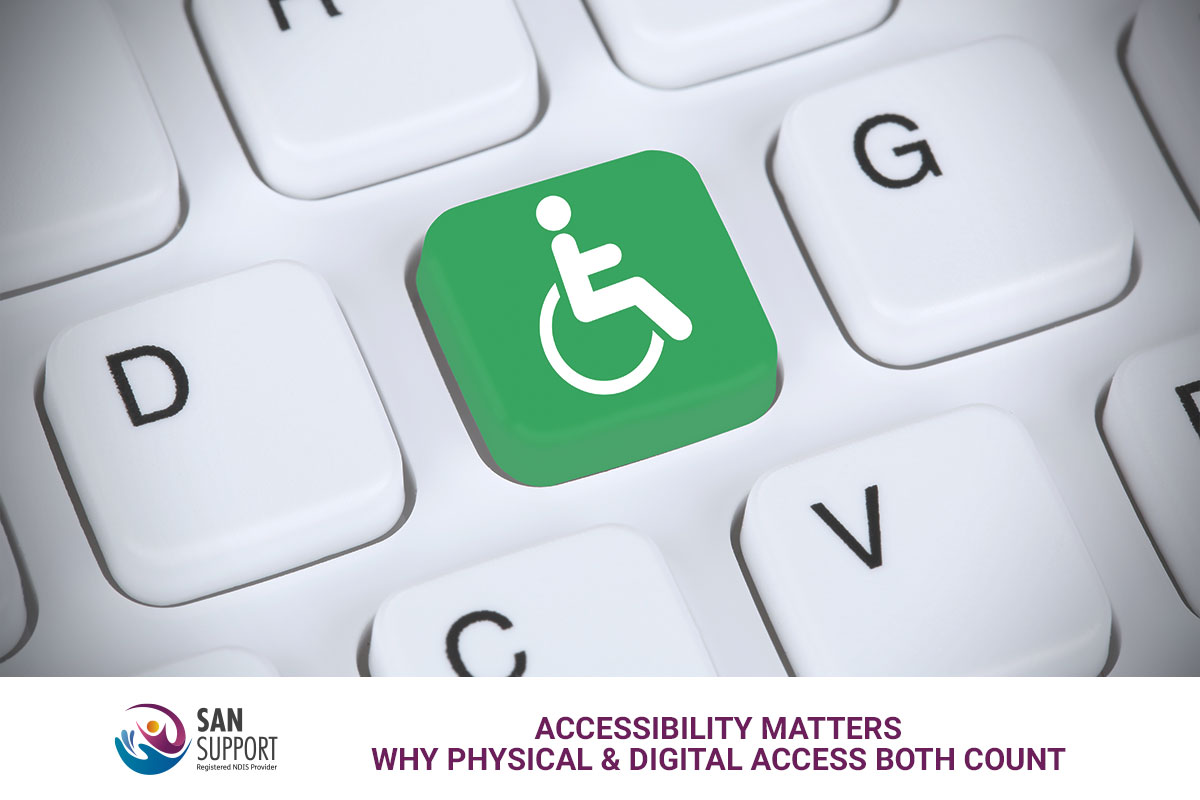
Accessibility is not only about ramps or lift access. It is about removing barriers wherever people live, travel, communicate, learn, and use services. That includes front doors, bathrooms, transport links, websites, PDFs, online bookings, and mobile apps. When one part fails, participation becomes harder. That is why accessibility matters in both physical and digital spaces.
Physical accessibility shapes everyday independence
Physical accessibility affects how safely and confidently a person moves through daily life. The Queensland Government’s housing principles for inclusive communities say housing should be safe, easy to adapt, and easy to access, navigate, visit, and live in. Those principles also focus on rights, choice, control, and inclusion. For Brisbane families and NDIS participants, that makes physical accessibility more than a design issue. It becomes a quality-of-life issue.
In practical terms, physical accessibility can include step-free entry, wider pathways, accessible bathrooms, safer circulation areas, and layouts that support routine and independence. It also includes environments that reduce confusion and stress. Good physical design helps people enter a space, move through it, and use it with dignity. That matters at home, during appointments, and in community settings across Brisbane. These outcomes align with Queensland’s focus on homes that people can access, navigate, visit, and live in more easily.
Digital accessibility now matters just as much
Digital access has become essential because many services now begin online. Information sheets, intake forms, appointment systems, plan updates, social posts, and provider websites often shape the first contact a person has with a service. The Australian Human Rights Commission says organisations should provide equal access to digital goods and services and notes that meeting relevant standards helps organisations meet their obligations under the Disability Discrimination Act. The Commission also says those standards are the minimum organisations should aim for.
That matters because a service can appear welcoming in person but still exclude people online. A person may struggle to read low-contrast text, complete a form with a screen reader, understand a cluttered layout, or use a PDF that does not work with assistive technology. If a website or app blocks access, the barrier appears before support even begins. In that sense, digital accessibility is not an extra feature. It is part of basic access.
What good digital accessibility looks like
The World Wide Web Consortium explains that WCAG is the shared international standard for web accessibility. WCAG 2.2 groups accessibility under four principles. Content should be perceivable, operable, understandable, and robust. It also uses conformance levels A, AA, and AAA. W3C encourages organisations to use the latest version of WCAG. For disability service providers, this gives a clear framework for making websites and digital content easier to use.
In plain language, that means text should be readable, images should have useful alternative text, forms should work with keyboards, videos should support accessible use, and page structure should make sense. Online content should not confuse people or require perfect vision, hearing, dexterity, or memory. These improvements support people with disability, but they also help older users, carers, and busy families who need clear information quickly. That practical benefit follows directly from WCAG’s focus on making web content more accessible to people with disabilities.
Why both types of access must work together
Physical and digital accessibility should never sit in separate conversations. A home may be well designed, but the application process may be hard to use. A clinic may have accessible entry, but its website may hide key information in an unreadable PDF. A provider may offer strong supports, but its booking system may fail on mobile devices or assistive technology. Access only works properly when the full journey works. The Australian Human Rights Commission’s digital access guidance and Queensland’s inclusive housing principles support that broader view of access.
This matters for NDIS participants in Brisbane because support often crosses home, transport, community, and digital systems in one day. Someone may search online, call a provider, attend an appointment, review documents, and then return home to manage routines. Each step should feel usable and respectful. When access breaks at any point, people lose time, confidence, and choice. When access improves, participation becomes easier and more consistent. That is a practical inference from the way official guidance treats access as part of equal participation and inclusion.
A simple way to think about accessibility
A useful test is this: can a person find the service, understand the information, enter the space, use the service, and follow up without extra barriers? If the answer is no at any stage, accessibility still needs work. This test applies to homes, SDA environments, websites, contact forms, blogs, and service pages alike. Accessibility should support people before, during, and after they use a service. That approach matches the Queensland focus on access and inclusion, and the W3C focus on usable digital content.
Accessibility matters because inclusion should not depend on luck, extra effort, or workarounds. Good access supports independence, communication, safety, and participation. In Brisbane, the strongest services will keep improving both the physical environment and the digital experience. That is how accessibility moves from a compliance idea to an everyday standard people can actually feel.
Final Thoughts
For Brisbane participants looking for practical disability support, SAN Support provides Support Coordination, Personal Care and In Home Supports, Community and Civic Participation, Supported Independent Living, Allied Health, Occupational Therapy, Speech Pathology, NDIS Plan Management, and Specialist Disability Accommodation. The SAN Support blog also publishes Brisbane-focused NDIS articles for participants and families.
Explore SDA Properties: SIL / SDA Properties in Brisbane
Learn more about NDIS